Key takeaways
- A comet is a small body of ice, rock and dust, often only a few kilometres across, that grows a coma and tails when it nears the sun.
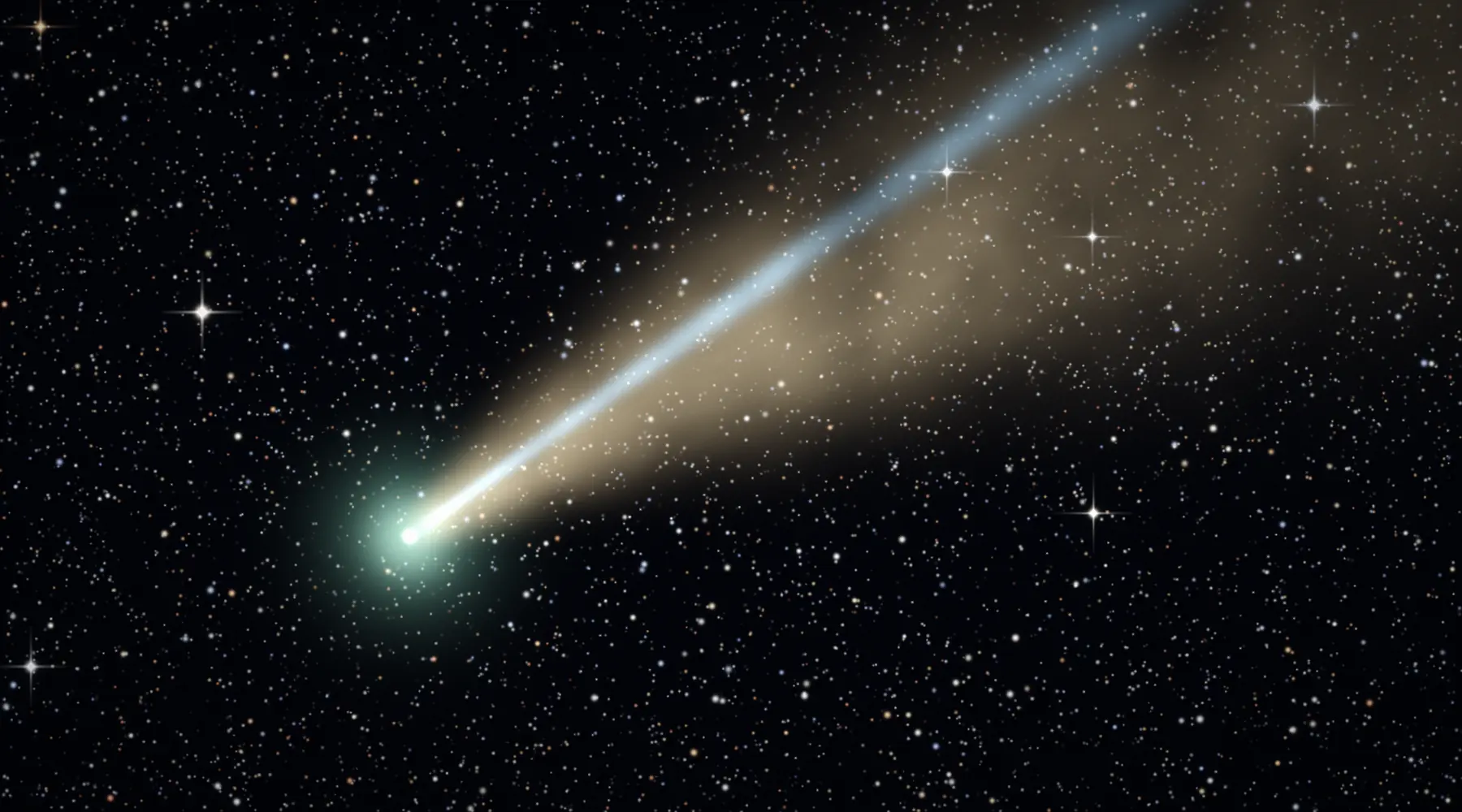
- The dust tail is pushed by sunlight, and it is broad, curved and yellowish-white. The ion tail is swept away by the solar wind, and it is thin, straight and bluish.
- Both tails point away from the sun, so a comet that is leaving the sun flies tail first.
- Photograph a bright comet on a moonless night with a lens of 85 to 200 millimetres, 10 to 30 seconds on a fixed tripod, and take many frames.
A comet has two tails because the sun acts on its escaping material in two ways. Sunlight pushes the dust into a broad, curved, yellowish tail, while the solar wind carries the ionised gas into a thin, straight, bluish one. Both point away from the sun.
A comet is a small body of ice, rock and dust, often only a few kilometres across, that spends most of its life in the cold dark far from the sun. Only when its orbit brings it closer to the sun does it begin to look like the pictures in the books.
The parts of a comet
| Part | What it is | What it looks like |
|---|---|---|
| Nucleus | The solid core of ice, rock and dust | Too small to see, usually a few kilometres across |
| Coma | A huge, thin cloud of gas and dust around the nucleus | A fuzzy glow that can be larger than a planet |
| Dust tail | Dust pushed away by the pressure of sunlight | Broad, curved and yellowish-white |
| Ion tail | Gas ionised by ultraviolet light and swept away by the solar wind | Thin, straight and bluish |
The coma and the two tails
As sunlight warms the ice, the surface turns directly into gas, and the escaping gas drags dust with it. This forms a huge, thin cloud called the coma around the nucleus, which can be larger than a planet. The sun then shapes the coma into two different tails.
| Feature | Dust tail | Ion tail |
|---|---|---|
| Made of | Dust grains | Ionised gas |
| Pushed by | The pressure of sunlight | The solar wind |
| Colour | Yellowish-white, from reflected sunlight | Bluish, from the glow of ionised carbon monoxide |
| Shape | Broad and often curved, because the dust continues along the comet's orbit as it drifts | Thin and straight |
| Direction | Away from the sun, curving back along the orbit | Almost exactly away from the sun |
Both tails point away from the sun, which means that after a comet has passed its closest point and starts to move outward, it flies tail first. Some comets show extras. The bright comet Hale-Bopp in 1997 also displayed a faint third tail of sodium, and an apparent tail that points towards the sun, called an anti-tail, can appear as an effect of perspective when the earth crosses the plane of the comet's orbit.
A comet's tail points away from the sun, never behind the comet. After closest approach, it flies tail first.
Short-period and long-period comets
| Family | Time to orbit the sun | Where it comes from | An example |
|---|---|---|---|
| Short-period (Jupiter family) | Under about 20 years | The region beyond Neptune | Comet 67P/Churyumov-Gerasimenko, about 6.4 years |
| Halley type | About 20 to 200 years | Thought to come from the far outer solar system | Halley's comet, about 76 years, next due in 2061 |
| Long-period | More than 200 years, sometimes thousands | The distant Oort Cloud | Comet Hale-Bopp, about 2,500 years |
Finding out when and where
Comets come in two kinds from a photographer's point of view: the very few that become bright enough to see easily, which are discussed for months beforehand, and the many faint ones that need a camera. Comet NEOWISE in July 2020 was one of the easy ones. The brightness of a comet is notoriously hard to predict, so treat forecasts with caution. AstroNight takes orbit and brightness data for comets from the NASA Jet Propulsion Laboratory and shows the interesting ones in its calendar, so you can plan an evening around them.
Photographing a comet
- Choose a night with no moon, because the outer parts of the tails are faint, as explained in choosing a target when the moon is bright.
- Use a focal length of 85 to 200 millimetres for a bright comet, and more for a small one.
- Expose for 10 to 30 seconds with a fixed tripod, or for longer with a tracker, taking many frames.
- Remember that comets move against the background stars. For a slow one this barely matters, but a fast one needs shorter exposures or two separate stacks, one aligned on the stars and one on the comet, combined afterwards.
| Situation | Focal length | Exposure | Note |
|---|---|---|---|
| A bright comet with a long tail | 85 to 200 mm | 10 to 30 seconds on a fixed tripod | Frame the whole tail |
| A small or faint comet | 200 mm or longer | Longer exposures on a tracker | Collect many frames and stack them |
| A fast comet close to the earth | Any | Shorter exposures, or two stacks | The comet moves visibly against the stars |
The dust that comets leave behind is also the source of meteor showers, a subject covered in catching a meteor shower.
A first comet is a special moment. It is a visitor from the early solar system, over four and a half billion years old, and you can photograph it from your own back garden.
Frequently asked questions
Why do comet tails point away from the sun?
Because the sun pushes them. Sunlight presses on the dust, and the solar wind carries the ionised gas away, so both tails stream away from the sun whichever way the comet is moving. After closest approach, a comet leaves the sun tail first.
What are the two tails of a comet made of?
The dust tail is made of tiny grains that reflect sunlight, which gives it a yellowish-white colour. The ion tail is made of gas ionised by ultraviolet light, and its bluish glow comes mainly from ionised carbon monoxide.
How long does a comet take to orbit the sun?
It varies enormously. Short-period comets take less than 200 years, and Halley's comet takes about 76 years. Long-period comets take more than 200 years, and some, like Hale-Bopp, take thousands.
What settings should I use to photograph a comet?
For a bright comet, use a lens of 85 to 200 millimetres and expose for 10 to 30 seconds on a fixed tripod, taking many frames. With a star tracker you can expose for longer. Choose a night without moonlight.
When is the next bright comet?
Nobody can say for sure, because the brightness of a comet is hard to predict. The helpful approach is to watch a calendar of current comets, which AstroNight builds from NASA Jet Propulsion Laboratory data, and to treat forecasts with caution.
Sources and further reading
AstroNight is now on the App Store. The free planner and coach for astrophotography works on iPhone and iPad with iOS 17 or later, offline, with no account. Get it on the App Store.