Key takeaways
- A meteor shower happens when the earth passes through a stream of debris left by a comet or an asteroid. Each meteor is usually a speck of dust no bigger than a grain of sand.
- Aim your widest lens 30 to 60 degrees away from the radiant, not at it, because meteors near the radiant look short.
- Use 15 to 20 seconds at ISO 3200, the aperture wide open and an interval timer with the shortest gap, and expect one frame in ten to twenty to hold a meteor.
- Choose a night with a thin or setting moon. For Finland the Geminids in December and the Perseids in August are the best bets.
A meteor shower happens when the earth passes through a stream of dust left behind by a comet or an asteroid, and you can photograph one with a wide lens, a tripod and an interval timer that keeps the shutter open almost all the time.
A shooting star is not a star. It is usually a speck of dust no larger than a grain of sand, travelling at tens of kilometres per second, that burns up about a hundred kilometres above your head and leaves a streak of glowing air.
Meteor, meteoroid or meteorite?
The words are often mixed up, and it helps to know which is which.
| Word | What it means |
|---|---|
| Meteoroid | A small piece of rock, metal or dust travelling through space, from a grain up to about a metre across |
| Meteor | The streak of light made when a meteoroid burns up in the atmosphere, also called a shooting star |
| Fireball | An especially bright meteor, brighter than the planet Venus |
| Meteorite | A piece that survives the journey and lands on the ground |
Where the showers come from
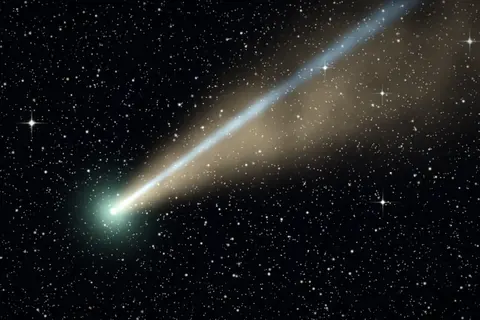
Each shower has its own parent. The Perseids in August come from the comet Swift-Tuttle, and the Orionids in October and the Eta Aquariids in May come from the dust of Halley's comet. The Geminids in December are unusual, because their parent is an asteroid, 3200 Phaethon. Comets shed dust as the sun warms them, which is the process described in why a comet has two tails, and the earth meets the same trail at the same time each year.
| Shower | Peak | Parent body | Typical rate at the peak | For observers in Finland |
|---|---|---|---|---|
| Quadrantids | 3 to 4 January | Asteroid 2003 EH1 | 80 to 110 | A very short peak of a few hours, and bitterly cold |
| Lyrids | 22 April | Comet Thatcher | About 18 | Short nights, so the sky is only just dark enough |
| Eta Aquariids | 5 to 6 May | Halley's comet | About 50 | Poor, because the radiant stays low and the sky is light |
| Perseids | 12 to 13 August | Comet Swift-Tuttle | About 100 | The sky is darkening again, and it is excellent without the moon |
| Orionids | About 21 October | Halley's comet | About 20 | Pleasant dark nights, with a modest rate |
| Leonids | 17 to 18 November | Comet Tempel-Tuttle | About 15 | Usually modest, with rare storms |
| Geminids | 13 to 14 December | Asteroid 3200 Phaethon | About 150 | The best of the year, with long dark nights and a high radiant |
| Ursids | About 22 December | Comet Tuttle | About 10 | Quiet, with a radiant that never sets |
The rate in the table is the zenithal hourly rate, usually shortened to ZHR. It is the number of meteors a single observer would see in an hour under a perfectly dark sky with the radiant straight overhead. Real skies are never perfect and the radiant is rarely overhead, so what you actually see is usually a fraction of the figure.
The radiant, and a common mistake
All the meteors of a shower seem to spread from one point of the sky, the radiant, which gives the shower its name. It is an effect of perspective, like snowflakes streaming out of the centre of your view when you drive through a snowfall at night. Many people point their cameras at the radiant, but the meteors near it appear short, since they are travelling towards you. Aim a little away from it, perhaps 30 to 60 degrees to one side, and the trails will be longer and more dramatic. Meteors can appear anywhere in the sky, so a wide lens is better than a long one.
Aim away from the radiant. The longest, most dramatic trails are 30 to 60 degrees to one side of it.
Camera settings
| Setting | Starting point | Why |
|---|---|---|
| Lens | The widest you own | A meteor can appear anywhere, and a wide view catches more of them |
| Aperture | Fully open | Meteors are brief and often faint |
| Exposure | 15 to 20 seconds | Long enough to record faint streaks without trailing the stars much |
| ISO | 3200, or lower in a bright sky | Raise it only if the frames are too dark |
| Focus | Manual, on a bright star | Autofocus fails in the dark |
| Drive mode | Continuous, or an interval timer with a 1 second gap | The camera should almost never be idle |
Here is the whole routine in order.
- Pick the night. Check the date of the peak and the phase of the moon, and choose a night when the moon is thin or sets early.
- Choose a place. Find a dark site with a wide view of the sky, arrive early and let your eyes adapt to the dark for 20 to 30 minutes.
- Frame wide. Use your widest lens with the aperture fully open, aimed 30 to 60 degrees to one side of the radiant, on a steady tripod.
- Set the exposure. Focus on a bright star and then leave the focus alone. Set 15 to 20 seconds at ISO 3200, or lower if the sky is bright.
- Start the sequence. Use continuous shooting or an interval timer with the shortest gap, so that the camera is almost always taking a picture, and check the battery and the lens for dew.
- Review and combine. Look through the frames afterwards, keep the ones that hold meteors and, if you like, combine a few into one picture with a note about how it was made.
Do not expect every frame to contain a meteor. A catch rate of one useful frame in ten to twenty is a good evening, and the best photographers choose a sequence of three or four such frames and combine them into a single picture, with a note about how it was made. Leave the camera running for hours, and check the battery.
Plan around the moon
Meteors are brief and often faint, so moonlight spoils a shower more than it spoils most targets. A good night is one with a thin moon or one where the moon sets before the best hours. The calendar in AstroNight collects the dates of the major showers, so you can see them coming, and the plan shows the moon for each evening. The effect of the moon on every kind of target is covered in choosing a target when the moon is bright.
Look with your eyes too
The best way to enjoy a shower is to lie back on a blanket and watch with the naked eye, letting the camera work on its own. Give your eyes twenty minutes or more to adjust, and use a red light if you need one, as described in what red light does for your eyes. There is no better use of the long wait than looking at the sky.
Look'd up in perfect silence at the stars.
Frequently asked questions
What is the best meteor shower to photograph?
The Geminids in December and the Perseids in August are the most productive, with typical peak rates of about 150 and 100 meteors per hour. For Finland the Geminids are the best, thanks to long dark nights and a high radiant, though you must dress for the cold. The right night is always one with a thin or absent moon.
Where should I point my camera for a meteor shower?
Aim your widest lens 30 to 60 degrees to one side of the radiant, with a good amount of sky in the frame. Meteors near the radiant are travelling towards you and look short, while those farther away leave longer trails.
What camera settings should I use for meteors?
Start with your widest lens at its widest aperture, an exposure of 15 to 20 seconds, ISO 3200 (lower in a bright sky), manual focus on a star and continuous shooting or an interval timer with the shortest gap. Adjust after the first test frame.
Do I need a star tracker to photograph meteors?
No. A fixed tripod is enough, and it is the usual choice. A tracker keeps the stars sharp but also moves the camera with the sky, which makes no difference to a meteor streak and complicates the picture.
How many meteors will I catch on camera?
Far fewer than you see by eye. On a busy night, one frame in ten to twenty might hold a meteor, and many of those will be faint. Keep the camera running for hours and expect to discard most of what it records.
Sources and further reading
AstroNight is now on the App Store. The free planner and coach for astrophotography works on iPhone and iPad with iOS 17 or later, offline, with no account. Get it on the App Store.