Key takeaways
- The Moon is far brighter than the sky around it, so lower the exposure instead of raising it, and your moon photos will show craters instead of a white blob.
- Use the longest lens you have, set focus by hand on the edge of the Moon, and crop afterwards.
- A full moon looks flat. The best craters appear along the shadow line of a crescent or quarter moon.
- Moon photography is the best first target for the AstroNight manual camera, because the settings are quick to learn.
Why most moon photos fail
Nearly everyone has taken a moon photo that shows a glowing white dot. The phone measures the dark sky, decides the picture is dim and raises the exposure, which burns out the Moon. Good moon photography starts by remembering that the Moon is a sunlit rock and needs a daytime-style exposure.
A second problem is size. The Moon spans only about half a degree, which is roughly two per cent of the width of a telephoto frame. That is why every moon photo looks smaller than it did to your eyes, and why cropping is part of the method, not a failure.
If you are new to a manual camera, read our guide to the best iPhone settings for night sky photos first, then come back for the Moon.
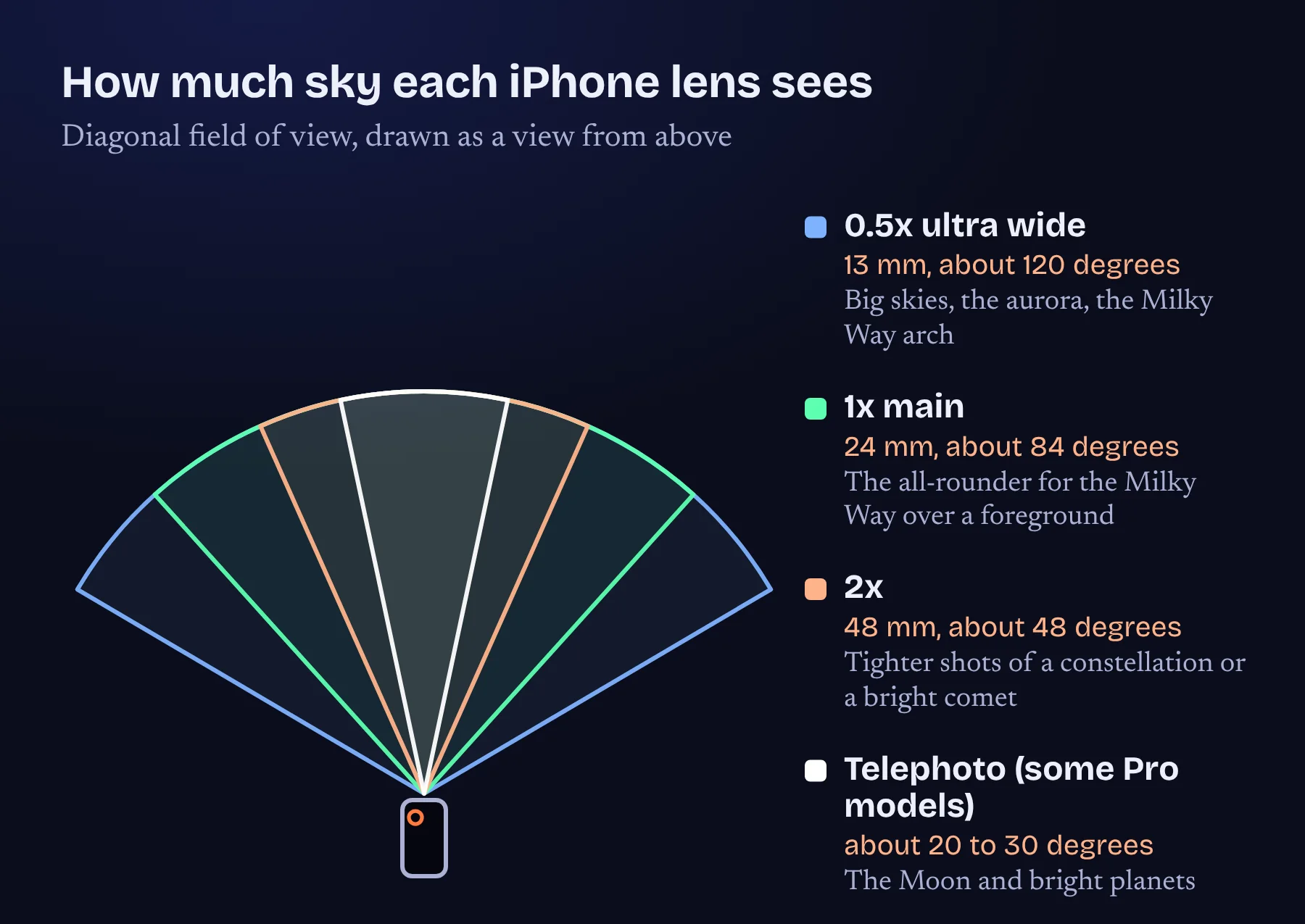
Settings that work for moon photos
Put the phone on a tripod, choose the longest lens and switch to manual control. Start with the numbers below and adjust from your first test frame.
| Moon | ISO | Exposure time | Focus | Notes |
|---|---|---|---|---|
| Full moon | Lowest available | About 1/500 s to 1/1000 s | Manual, on the edge | Bright and flat, so keep the highlights under control |
| Quarter moon | Lowest available | About 1/250 s to 1/500 s | Manual, on the shadow line | The best craters in the sharpest relief |
| Crescent | Low, 50 to 200 | About 1/60 s to 1/250 s | Manual | Try a longer exposure to show earthshine |
| Moon in a landscape | 100 to 400 | 1/30 s to 2 s | Manual, set on the Moon | Take a second, longer frame for the foreground and blend them |
These are starting points, not rules. Take a test frame, zoom in on the Moon and check that the edge is crisp and the bright areas still show detail. A full moon in particular rewards a darker exposure than looks right on the screen.
Phases, timing and the full moon trap
The full moon is the most popular target and the least interesting to photograph, because the sunlight arrives straight on and hides the shadows. A moon a few days either side of full still gives a bright, easy picture, and the quarter phases show far more texture. Plan around the phase, the weather and the rising time, which is exactly what AstroNight does when it chooses tonight's targets.
A low moon near the horizon looks huge beside trees and buildings. That is an illusion of the eye, but the camera can use it: shoot a longer lens from far away to keep a big moon behind a small foreground.
The Moon also moves quickly. The sky turns about 15 degrees an hour, so the Moon crosses its own width in roughly two minutes. For a bright moon this does not matter, but see how choosing a target under a bright moon explains what the phases mean for everything else.
Sharpening and editing your moon photos
Shoot RAW if your camera allows it, take ten or twenty frames in a row and choose the sharpest. Stacking several frames, as described in why a hundred frames beat one, reduces noise and lets you sharpen the craters more. Crop to the Moon, lift the contrast a little, and keep the colour natural. The Moon is a soft grey with a hint of gold or blue, not a hard black and white.
Finally, keep a note of what worked. A repeatable recipe is the real prize of moon photography: next month the same settings will give you the same result.
Frequently asked questions
What is the best lens on an iPhone for moon photography?
The longest one you have. A telephoto lens makes the Moon the largest in the frame, and you can crop afterwards. A wide lens makes it a tiny dot, however good the settings.
Why are my moon photos just a white blob?
The camera is exposing for the dark sky and burning out the Moon. Switch to manual control, lower the exposure time and the ISO, and check the result on a zoomed-in test frame.
Can I photograph the full moon with the standard camera app?
Yes, but lower the exposure slider before you shoot and tap on the Moon to focus. A manual camera is more repeatable, because it fixes the exposure and the focus between shots.
When is the best time for moon photos?
A few days after new moon or before full moon, when the shadow line shows the craters. The full moon is bright but flat.
Sources and further reading
AstroNight is now on the App Store. The free planner and coach for astrophotography works on iPhone and iPad with iOS 17 or later, offline, with no account. Get it on the App Store.