Key takeaways
- The centre of the Milky Way lies in Sagittarius at a declination of about minus 29 degrees, so its highest possible altitude is 90 degrees minus your latitude minus 29 degrees.
- From Helsinki that is about one degree, lost in haze and rooftops, and north of about 61 degrees it never rises at all.
- The northern Milky Way is a rich prize in its own right, and it is at its best in Finland from late August to the early winter.
- To photograph the core, travel south in summer to a place such as Spain, Italy, Greece or the Canary Islands.
The bright core of the Milky Way sits at a declination of about minus 29 degrees, so from Helsinki it climbs to only about one degree above the horizon, and from about 61 degrees north it never rises at all. That is simple geometry, not bad luck.
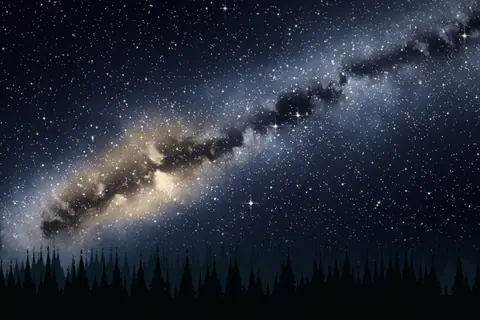
Look at the Milky Way pictures that fill the internet, with a bright, lumpy golden bulge rising from a desert or a mountain, and you are almost always looking at one direction of the sky: towards the centre of our galaxy. Photographers who live in southern countries can simply go outside. For those of us in the north, the picture is a little more complicated.
Where the galactic centre sits
The centre of the Milky Way lies in the constellation Sagittarius, at a declination of about minus 29 degrees. Declination is the sky's version of latitude, so this point sits well south of the celestial equator. A star reaches its highest point in the sky at an altitude of 90 degrees minus the difference between your latitude and the star's declination. For the galactic centre that means 90 degrees, minus your latitude, minus 29 degrees.
At 60 degrees north, which is roughly where Helsinki lies, that comes to about one degree above the horizon, and only for a moment. In practice it is lost in haze, trees and rooftops. From about 61 degrees northwards it never rises at all. This is the whole reason why the galactic core is a dream for people in northern Europe and an easy target for people in Spain, Italy or further south.
A quick rule you can use anywhere
To find how high a target can climb, take the difference between your latitude and its declination, ignoring the sign, and subtract that from 90. If the answer is under about 20 degrees, expect a difficult photograph, because the light travels through a thick slab of air and the result is dim and orange. This calculation is also the logic behind a planner such as AstroNight, which only suggests targets that rise high enough from where you are.
| Place | Latitude | Highest altitude of the core |
|---|---|---|
| Rovaniemi | 66.5° N | Never rises |
| Oulu | 65.0° N | Never rises |
| Tampere | 61.5° N | Never rises |
| Helsinki | 60.2° N | About 1° |
| Stockholm | 59.3° N | About 2° |
| Copenhagen | 55.7° N | About 5° |
| Berlin | 52.5° N | About 8° |
| Paris | 48.9° N | About 12° |
| Rome | 41.9° N | About 19° |
| Madrid | 40.4° N | About 21° |
| Athens | 38.0° N | About 23° |
| Tenerife | 28.3° N | About 33° |
| Sydney | 33.9° S | About 85° |
The galactic core is not hiding. It is simply below the horizon, and always will be from Finland.
What the north offers instead
It would be a mistake to think the northern Milky Way is a consolation prize. The part of the band that crosses Cassiopeia, Cepheus and Cygnus is full of rich fields of stars, dark lanes and nebulae, and it rises high in the sky on autumn evenings, right when the nights in Finland grow long enough to be useful again. The North America Nebula and the Veil Nebula in Cygnus reward modest lenses and patient stacking, and the double cluster in Perseus is lovely in even a short exposure.
| Region | Constellations | Best from Finland | Highlights |
|---|---|---|---|
| The summer and autumn band | Cygnus, Cepheus, Cassiopeia | Late August to autumn evenings | The North America Nebula, the Veil Nebula, the Heart and Soul Nebulae |
| The Perseus and Auriga band | Perseus, Auriga | Autumn into winter | The Double Cluster, rich star fields |
| The winter band | Orion, Monoceros, Gemini | Winter | The Orion Nebula and the Rosette Nebula region |
The summer months are poor for another reason, which is that the sky does not get dark at all, and that is the subject of another article. So the best period for the Milky Way in Finland is between late August and the early winter, when the band stands overhead like an arch. The autumn is also the aurora season, so the same night can offer both, as described in chasing the northern lights.
If you still want the core
The solution is travel. A trip to southern Europe in summer, where the core reaches 15 to 25 degrees above the horizon, will give you a picture that is impossible at home. Plan the dates around the new moon and look at where the core is at different times of night before you book, because the core rises, crosses the south, and sets within a few hours, and the best photographs are made when it is highest. The same plan works for the Canary Islands, which lie much further south. For the camera work itself, start with your first night with a camera and a tripod.
Frequently asked questions
Can you see the Milky Way core from Finland?
No. The galactic centre is at a declination of about minus 29 degrees, so from Helsinki it climbs only about one degree above the horizon, and from about 61 degrees north it never rises at all. You can see the rest of the Milky Way, but not its bright core.
When is the Milky Way visible in Finland?
The best period is from late August, when the sky is dark again, until the early winter, when the band arches over Cassiopeia and Cygnus. There is also a fainter winter band through Orion. The summer months are too bright, because the sky never gets fully dark.
How high is the galactic core from Helsinki?
About one degree above the horizon at its highest, and only for a moment. In practice haze, trees and buildings hide it completely.
Where can I photograph the galactic core in Europe?
The further south the better. Spain, Italy and Greece lift the core 19 to 23 degrees above the horizon, and the Canary Islands lift it to about 33 degrees. Go in summer, around a new moon.
What is declination?
It is the sky's version of latitude: the angle of an object north or south of the celestial equator. Together with the latitude of your observing site, it tells you how high the object can climb.
Sources and further reading
AstroNight is now on the App Store. The free planner and coach for astrophotography works on iPhone and iPad with iOS 17 or later, offline, with no account. Get it on the App Store.