Key takeaways
- Emission nebulae glow in a few specific colours: H-alpha (deep red, 656 nm), OIII (blue-green, 501 nm) and SII (deep red, 672 nm).
- A narrowband filter passes only a band 3 to 12 nanometres wide around one of those colours and blocks most of the moon, the streetlights and the sky glow.
- The price is less light, so you need longer total exposure. A dual-band filter on a colour camera is the easiest way in.
- Galaxies, reflection nebulae and most star clusters shine in all colours, so a narrowband filter is the wrong tool for them.
A narrowband filter passes only a thin slice of colour, typically 3 to 12 nanometres wide and centred on the glow of hydrogen, oxygen or sulphur. It blocks most of the moon, the streetlights and the sky, so an emission nebula can still shine on a bright night.
Look through the equipment lists of experienced astrophotographers, and you will find mysterious names like H-alpha, OIII and SII, usually with a number such as 7 nm. They sound like laboratory notes, but the idea behind them is neat and easy to grasp.
Gas glows in particular colours
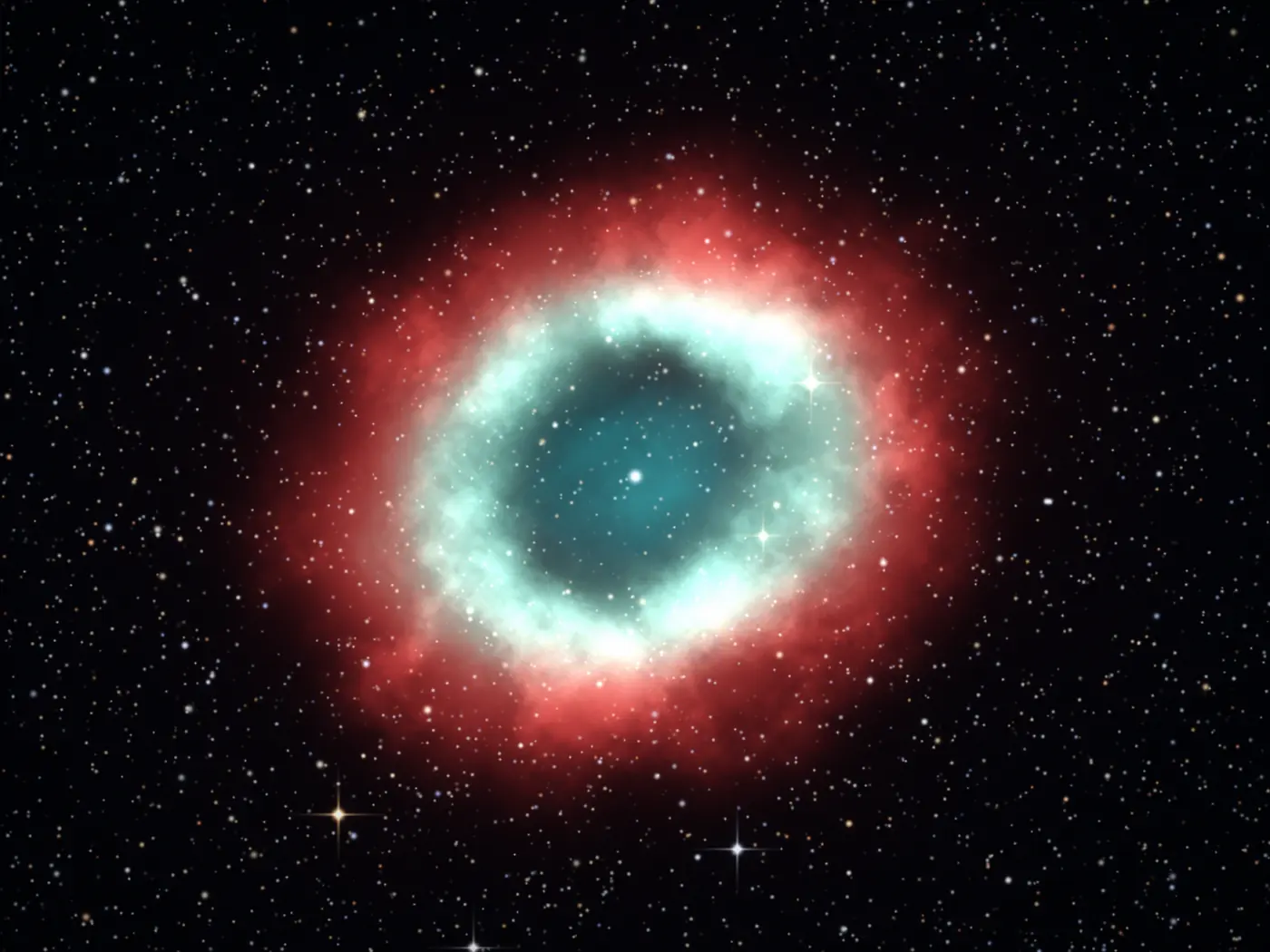
An emission nebula is a cloud of gas that has been energised by hot stars nearby. Like the gas in a neon sign, each element shines in a few specific colours, and nothing else. The three that matter most are hydrogen, oxygen and sulphur.
| Name | Element | Wavelength | Colour | Where it is strong |
|---|---|---|---|---|
| H-alpha | Hydrogen | 656 nm | Deep red | Almost every emission nebula, and the strongest signal of the three |
| OIII | Oxygen (doubly ionised) | 501 nm | Blue-green or teal | Planetary nebulae and supernova remnants |
| SII | Sulphur (singly ionised) | 672 nm | Deep red | Fainter, but it adds detail |
| H-beta | Hydrogen | 486 nm | Blue-cyan | Fainter, and used less often |
The trick: let through only those colours
The light of the moon, of streetlights and of the sky itself is spread across all colours, like white light. A narrowband filter has a very narrow passband, typically 3 to 12 nanometres wide, centred on one of those wavelengths. It blocks nearly everything else. The nebula's light passes through unharmed, while the greater part of the sky glow is stopped. The result is a picture of a nebula with a dark background, even when the moon is bright or the sky is orange.
That is why narrowband imaging suits the nights that other photographers give up on, and why AstroNight leans towards bright nebulae and narrowband when the moon is high, as explained in choosing a target when the moon is bright. It also suits the pale summer nights of the north, as described in our article on the white nights.
The width of the band is a trade-off.
| Bandwidth | Strength | Weakness |
|---|---|---|
| 3 nm | The darkest background and the best contrast, and it separates H-alpha from a nearby nitrogen line | Needs slower optics, and exposures are longer |
| 5 to 7 nm | The sensible all-round choice | A little more sky glow gets through |
| 12 nm | Cheaper and brighter, and easier with fast lenses | Lets through more moon and town light |
A filter's passband also shifts slightly towards shorter wavelengths for light that arrives at a steep angle. This is why a very fast lens, around f/2, works better with a wider band.
Narrowband, broadband and everything between
| Approach | Light that passes | Best for | Under the moon or in town |
|---|---|---|---|
| No filter, or a plain broadband filter | All colours | Galaxies, reflection nebulae, clusters and the Milky Way | Poorly |
| Light pollution filter | All colours except common artificial light | Galaxies and nebulae from a town | A little better |
| Dual-band filter | H-alpha and OIII together | Emission nebulae with a colour camera | Very well |
| Separate narrowband filters | One line at a time | Emission nebulae, planetary nebulae, supernova remnants | Best of all |
The cost
A narrowband filter throws away most of the light, so exposures must be longer, and you need more frames, because the signal grows only with the square root of the number of frames, as explained in why a hundred frames beat one. Filters work best with a cooled or at least modified camera, since an ordinary camera's colour filters block much of the deep red.
| Approach | Camera | Filters | Advantages | Drawbacks |
|---|---|---|---|---|
| One shot colour | A colour camera, ideally modified or cooled | One dual-band filter | Simple and quick, with two colours in each frame | Less control over each colour |
| Mono with filters | A monochrome camera | A filter wheel with H-alpha, OIII and SII | The best contrast and full control | More cost, more frames and more processing |
Many photographers begin with a dual-band filter, which passes H-alpha and OIII at once and works with a colour camera, so a single exposure captures both.
When a filter will not help
Galaxies, reflection nebulae and most star clusters shine with the light of ordinary stars, spread over all colours. A narrowband filter would remove most of their light, so it is the wrong tool for them. A broadband light pollution filter can help a little with these, although nothing replaces a dark sky, as the Bortle scale article explains.
False colour and honesty
Narrowband pictures are often shown in the "Hubble palette", where sulphur is mapped to red, hydrogen to green and oxygen to blue. This is a deliberate false colour, chosen to show the structure of the gas. It is a legitimate artistic and scientific choice, as long as you say so when you share the picture.
| Palette | Red channel | Green channel | Blue channel | The look |
|---|---|---|---|---|
| Hubble palette (SHO) | SII | H-alpha | OIII | Gold and teal, with the structure of the gas on show |
| HOO | H-alpha | OIII | OIII | Closer to natural red and teal |
A false colour picture is honest as long as you say that it is false colour.
Frequently asked questions
What is a narrowband filter?
It is an optical filter that passes only a very thin range of wavelengths, usually 3 to 12 nanometres wide, around the colour emitted by hydrogen, oxygen or sulphur. It blocks most of the light from the moon, the sky and streetlights, so emission nebulae stand out.
Do narrowband filters work in light pollution or under a full moon?
Yes, that is their great strength. Because most artificial and lunar light is spread across all colours, a narrowband filter removes the greater part of it. You still need a clear sky, and a very bright moon close to the target will still brighten the background.
What do H-alpha, OIII and SII mean?
They are the names of three emission lines. H-alpha is deep red light from hydrogen, OIII is blue-green light from doubly ionised oxygen and SII is deep red light from singly ionised sulphur. Filters are made to pass each one.
Do I need a monochrome camera for narrowband imaging?
No. A colour camera with a dual-band filter is a simple and popular way to start. A monochrome camera with separate filters gives better contrast and more control, but it costs more and needs more time.
What is the Hubble palette?
It is a false colour scheme in which sulphur light is shown as red, hydrogen as green and oxygen as blue. It brings out the structure of a nebula and gives the familiar gold and teal look, and it is good practice to mention it when you share a picture.
Sources and further reading
AstroNight is now on the App Store. The free planner and coach for astrophotography works on iPhone and iPad with iOS 17 or later, offline, with no account. Get it on the App Store.