Key takeaways
- Light pollution hides faint targets such as the Milky Way, but the Moon, the planets and the brightest stars are still within reach.
- City astrophotography works best with short exposures, a low ISO and many frames that you stack later.
- Shield your phone from streetlights and shoot after midnight, when many lights go out.
- A balcony is a real observatory: it is close, safe and free.
What light pollution does to your pictures
Light pollution is the glow of streetlights and buildings scattered by the air. It brightens the whole sky, so faint things sink below the background. A single bright photograph of a city sky shows an orange wash instead of a black one.
The darkness of a place is described by the Bortle scale, and most city balconies sit in classes 7 to 9. Our article on what the Bortle scale can and cannot tell you explains why the number is a starting point, not a verdict.
What you can shoot from a balcony
| Target | Bright city (class 8 to 9) | Suburb (class 6 to 7) |
|---|---|---|
| The Moon | Excellent | Excellent |
| Bright planets | Good, as bright discs | Good |
| Bright stars and constellations | Good with short exposures | Very good |
| Star trails | Possible with many short frames | Good |
| The Milky Way | Not possible | Seldom, only on the best nights |
| Faint nebulae and galaxies | Not possible with a phone | Only the brightest |
That is a respectable list for a place you can reach in thirty seconds. For brighter nights, read star trails the easy way, because trails are among the most forgiving subjects in a bright city.
Settings and tricks for city astrophotography
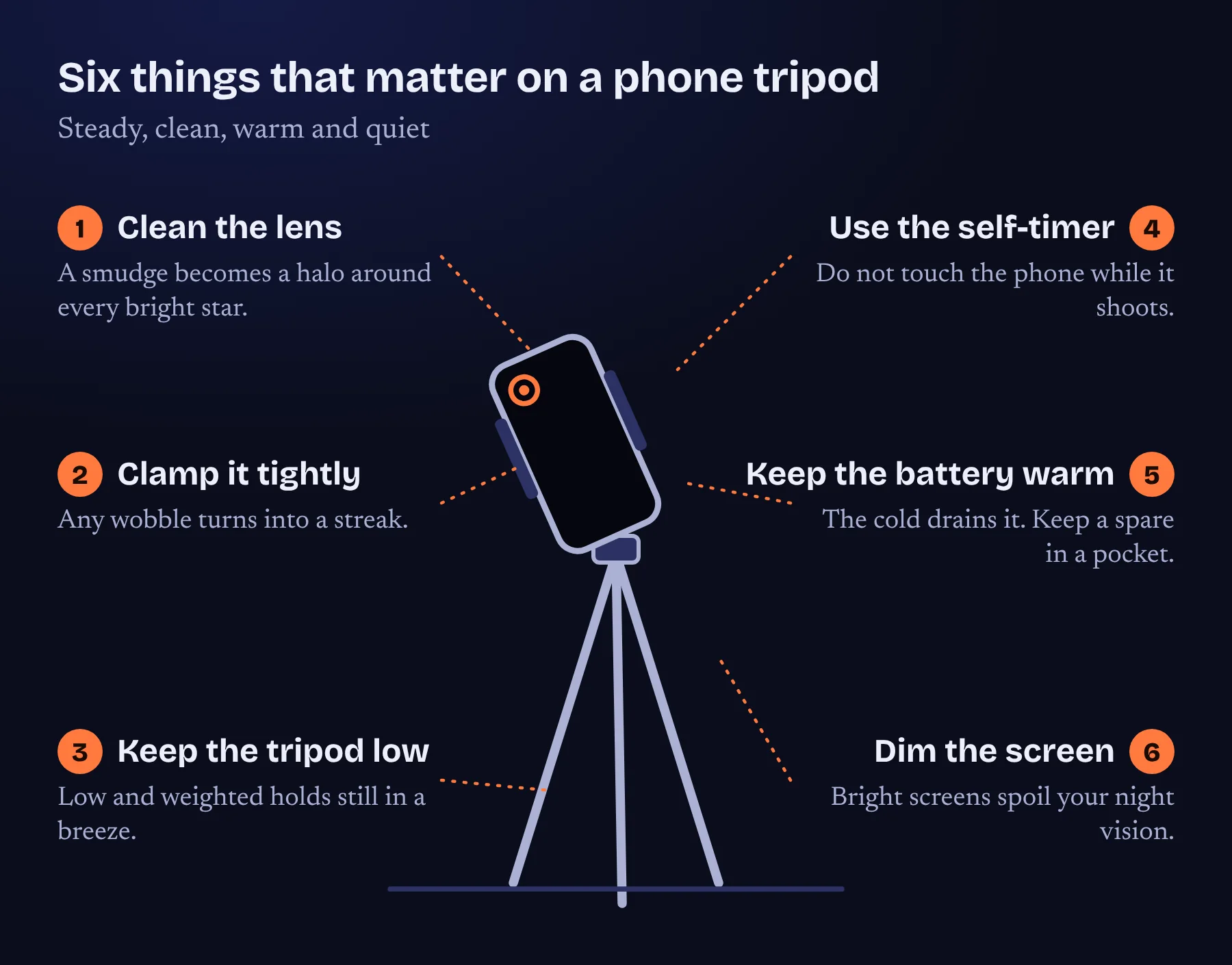
Keep exposures short, around 2 to 6 seconds, and the ISO low, around 400 to 800, so the sky glow does not fill the histogram. Take many frames and stack them. Use the balcony wall or a hood to shield the lens from direct light, and set the white balance by hand, because a city sky has an orange cast that automatic modes only make worse.
Time your sessions. Many lights switch off after midnight, and a clear, cold night after fresh snow brings a sharp, transparent sky, although the snow can also reflect light back up. Check the moon phase as well, as explained in choosing a target when the moon is bright.
Finally, check your balcony railing and the floor for vibration. Use the self-timer and, if you can, rest the tripod on a solid surface. A sharp frame with a steady setup beats a clever setting every time.
Making your balcony a habit
The best thing about city astrophotography is how often you can do it. Ten minutes on a clear night, three nights a week, teaches you more than one trip to the mountains a year. Keep a simple log of the date, the settings and the result, and watch your pictures improve.
Frequently asked questions
Can you do astrophotography in a city?
Yes. The Moon, bright planets and the brightest stars are all within reach, and star trails work well. Faint targets such as the Milky Way need a darker place.
Does a light pollution filter help an iPhone?
Not much. Filters are made for dedicated cameras and telescopes, and the best help for a phone is shielding the lens, short exposures and stacking.
What is the best time for city astrophotography?
Clear nights after midnight, when many lights are off, and on moonless nights for stars.
Can I photograph from a balcony with a phone?
Yes. A small tripod, the self-timer and a manual camera are enough, and a balcony is steady, safe and close to home.
Sources and further reading
AstroNight is now on the App Store. The free planner and coach for astrophotography works on iPhone and iPad with iOS 17 or later, offline, with no account. Get it on the App Store.